
17,000 readings: what a year of cat diabetes data showed
For almost a year now I have been keeping an open dataset drawn from a glucose and insulin diary — a year of cat diabetes data. In March 2026 it held 6,773 manual measurements from 121 pets. Today it’s 16,796 measurements from 166 pets: 153 cats and 13 dogs, spanning November 2025 – October 2026. The methodology is unchanged, so the two snapshots can be compared honestly: the difference is about the year, not about how we counted.
What’s in the data: the picture barely moved
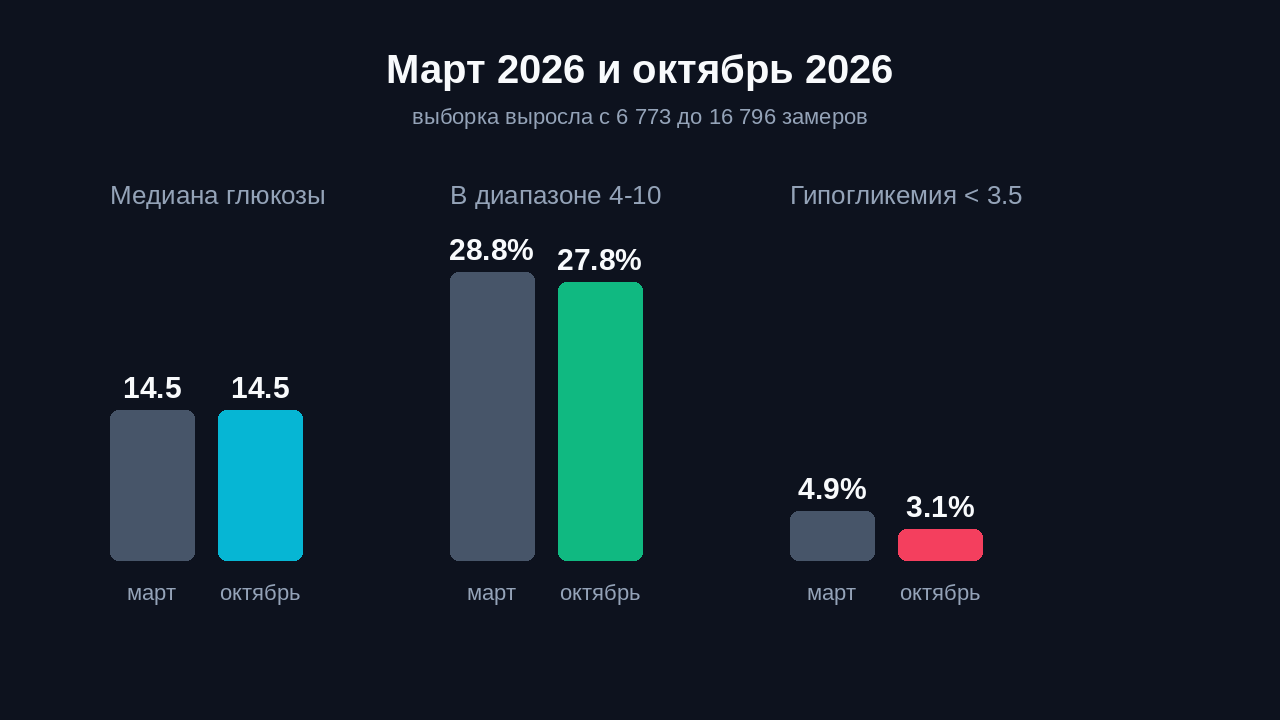
The median glucose didn’t move. 14.5 mmol/L in March and 14.5 mmol/L now. The sample has nearly tripled; the picture hasn’t.
Four to ten mmol/L is the target range owners set in the diary, not a veterinary norm. Right now 27.8% of measurements fall inside it, down from 28.8%. The share of readings below 3.5 mmol/L dropped from 4.9% to 3.1%. That’s the only column that improved — and even it isn’t about recovery. It’s more about the core group of owners dipping into the low range less often. And a clarification: it’s the column in the data that improved, a counter at a threshold — not proof that clinical hypoglycemic episodes became less common. This is a self-selected sample, and the mix of people measuring changed over the year. What hypoglycemia is and what to do about it is a separate story, covered in the overview article on diabetes in cats on diabetes in cats; here it is simply a counter in the data.
What grew: the habit, not the sugar
What grew wasn’t blood sugar but the habit of logging. The median number of entries per pet rose from 16 to 31. There are now 57 pets with 100+ measurements. Those who stayed are keeping the diary for months at a time. Those who showed up for two weeks after diagnosis and vanished are barely visible in this median.
Meanwhile, the typical pet on the platform is still living with persistently elevated blood sugar — chronic hyperglycemia. My takeaway is simple and unpleasant: access to monitoring, by itself, does not treat hyperglycemia. A diary doesn’t inject insulin, and it doesn’t choose food for the owner.
The second file: Libre and the night window
A second file has appeared: 10,418 points from FreeStyle Libre continuous monitoring. That’s 94 days from a single cat, roughly 96 readings a day instead of 1–3 by hand. With a manual glucose meter, the night is nearly invisible: people measure before and after the injection, usually morning and evening. A sensor measures all the time, including from three to seven, when the evening insulin is wearing off. On one poorly regulated cat, that window looks different from what the manual data shows.
While preparing the export, I found things in the data that had no business being there: profiles that didn’t behave like cats, and four “cats” that turned out to be a single sensor. How I caught it is a separate story about validation, not about sugar, and it stayed outside the scope of this article.
Why keep a diary if the median won’t budge
Our cat Manishka was diagnosed with diabetes in October 2025. I built the diary because the ready-made options didn’t work for me. A year later I can’t say that the mere existence of the app cured anyone. What I can say is this. Without a series of measurements, the vet has nothing to adjust the regimen with, and the owner has nothing to lean on between appointments. A diary is not treatment. A diary makes treatment visible.
The numbers, the charts, and both files — an anonymized dataset on GitHub under CC BY-NC — are covered in the full write-up on Habr. And if you need a place to keep your own measurements and doses, that’s exactly why I built the Diabnostic diary.
I’m a developer, not a veterinarian. These are observations from a self-selected dataset, not clinical recommendations.
Sources
- Sparkes AH, Cannon M, Church D, et al. ISFM Consensus Guidelines on the Practical Management of Diabetes Mellitus in Cats. J Feline Med Surg. 2015;17(3):235–250.
- Taylor S, Cannon M, Church D, et al. 2025 iCatCare consensus guidelines on the diagnosis and management of diabetes mellitus in cats. J Feline Med Surg. 2025;27(11).
- Bugbee A, Rucinsky R, Alvarez E, et al. 2026 AAHA Diabetes Management Guidelines for Cats. J Am Anim Hosp Assoc. 2026;62:65–93.